
OCD Explained: Symptoms, Myths, and Effective Treatment Options
You’ve probably heard people say, “I’m so OCD” about being tidy or organized. But real obsessive-compulsive disorder is far more complex — and far more serious — than that. This guide covers what OCD is, its common symptoms and types, the myths worth unlearning, and the treatments that actually work.
What is OCD?
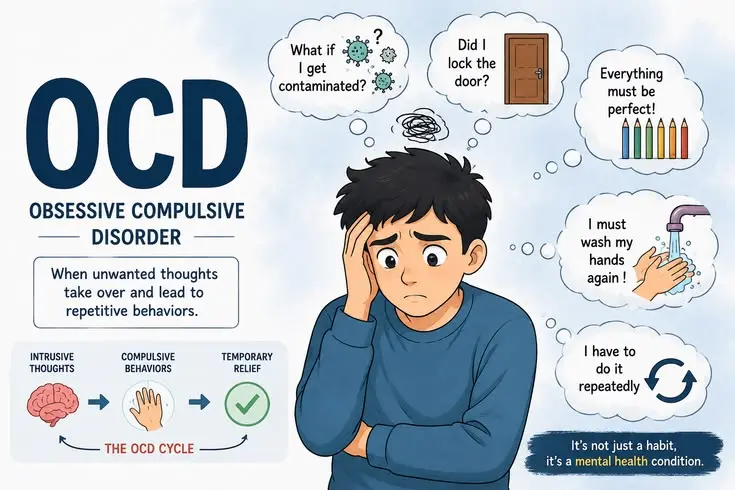
OCD stands for Obsessive-Compulsive Disorder, and it has two connected parts:
- Obsessions: unwanted, intrusive thoughts, images, or urges that cause anxiety or distress.
- Compulsions: repetitive behaviors or mental acts done to reduce that distress or prevent a feared outcome.
OCD is a diagnosable mental health condition, not a personality trait. Liking a tidy desk isn’t “a little OCD”—clinical OCD involves cycles of distress and is time-consuming enough to interfere with work, relationships, and daily life.
How the Cycle Works
- Trigger — a situation, thought, or feeling.
- Obsession — an intrusive thought creates fear or anxiety.
- Compulsion — a ritual is performed to neutralize the fear.
- Temporary relief — anxiety drops, but the cycle strengthens over time.
Every act of “relief” quietly reinforces the ritual as necessary, which is why OCD is so hard to break without support.
Common Types of OCD
- Contamination OCD — fear of germs or “dirty” objects, often paired with compulsive washing.
- Harm OCD — intrusive thoughts about hurting someone, which are feared, not desired.
- Sexual OCD — unwanted sexual thoughts that feel shameful or threatening.
- Religious/Moral OCD (Scrupulosity) — excessive worry about sinning or being immoral.
- “Just Right” OCD — a need for things to feel symmetrical or exactly correct.
- Relationship OCD — constant doubt about a partner or one’s own feelings.
Each shares the same structure — an intrusive obsession paired with a compulsion meant to relieve it — even though the theme varies.
OCD vs. Anxiety
Anxiety is a general sense of worry or fear. OCD pairs specific intrusive thoughts with compulsive rituals aimed at neutralizing them. Someone can have anxiety without OCD, but OCD almost always includes a strong anxiety component.
Common Myths About OCD
Myth: “OCD is just about being clean.” Reality: it can center on harm, morality, relationships, or symmetry; cleanliness is just one possible theme.
Myth: “People with OCD just need to relax.” Reality: OCD is clinical and typically needs professional treatment, not willpower.
Myth: “Intrusive thoughts mean you’re dangerous.” Reality: Intrusive thoughts are common in general. In OCD, they cause distress and drive compulsions, not action.
When to Seek Help
Consider professional support if:
- Symptoms take up significant time daily (often over an hour).
- They interfere with work, school, or relationships.
- You feel stuck in cycles you can’t control.
- You’re experiencing significant distress or low mood alongside them.
Look for a therapist trained in CBT and ERP (exposure and response prevention)—the most researched approaches for OCD.
Evidence-Based Treatments
- CBT: identifies and changes the thoughts and behaviors fueling OCD.
- ERP: gradually faces feared situations without performing the compulsion, letting anxiety decrease naturally.
- Medication: often SSRIs, prescribed by a psychiatrist.
- Combination therapy: many people benefit most from therapy and medication together.
Coping Strategies
- Learn about OCD from reliable sources.
- Practice delaying compulsions gradually, ideally with guidance.
- Use mindfulness to notice thoughts without reacting.
- Build routines that reduce stress.
- Stay connected to supportive people or groups.
Self-help works best alongside professional treatment, not instead of it.
Supporting Someone With OCD
- Don’t blame or shame them.
- Avoid participating in their compulsions, even to be kind.
- Encourage professional help.
- Be patient — change happens gradually.
- Learn about OCD together.
Conclusion
OCD is real, treatable, and widely misunderstood—far more than a quirk about tidiness. With the right treatment, especially CBT and ERP, most people see meaningful improvement. If you or someone you know struggles with OCD, reaching out to a professional is a strong first step.
If this topic feels personal to you, talking to a licensed therapist or doctor is a good place to start.
About the Author
Dr. Rati Chandra is a compassionate stress management and emotional well-being coach based in Bangalore, dedicated to helping individuals navigate life’s emotional and mental health challenges. With extensive experience in supporting people dealing with anxiety, stress, depression, relationship concerns, OCD, and personal growth, she believes that everyone deserves a safe, non-judgmental space to heal and thrive.
Her approach combines evidence-based psychological techniques with empathy and personalized care, empowering individuals to build resilience, improve emotional well-being, and lead more fulfilling lives. Through her articles, Dr. Rati Chandra aims to make mental health information easy to understand, reduce stigma, and encourage people to seek professional support when needed.
Whether you’re looking for guidance, clarity, or practical strategies to improve your mental well-being, Dr. Rati Chandra is committed to supporting you on your journey toward a healthier and happier life.